|
Scroll through the list and select an item then click the "Go!" button! |
The American Kennel Club Bouvier des Flandres - Breed standard: "The Bouvier des Flandres is a powerfully built, compact, short-coupled, rough-coated dog of notably rugged appearance. He gives the impression of great strength without any sign of heaviness or clumsiness in his overall makeup. He is agile, spirited and bold, yet his serene, well behaved disposition denotes his steady, resolute and fearless character. His gaze is alert and brilliant, depicting his intelligence, vigor and daring." |
|
Canadian Champion, UKC Grand Champion
See Maggie's Agility Scores and ranked #7 Agility Bouvier in AKC. |
to complete the course, it was difficult for our photograph, Judith Allen, to capture "the perfect picture". |
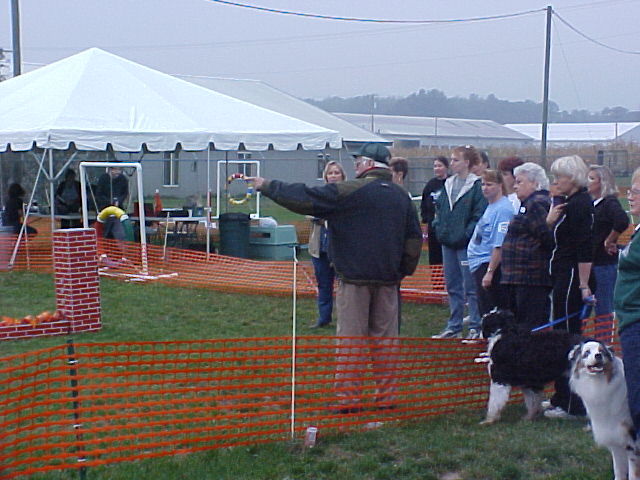 Judge Joe Reese explains the course to the handlers. |
Before each trial, the handlers (without their dogs) are allowed 5 minutes to walk through the course. This allows the handlers to become familiar with the layout of the course and to get an idea of the best place to be in order to direct the dog over the correct obstacle. |
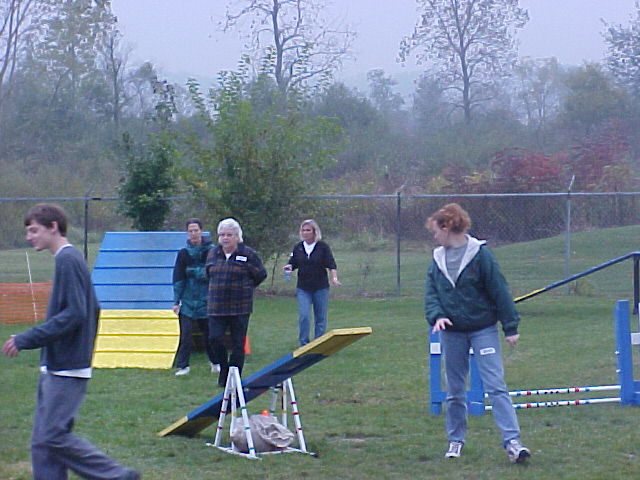 Lee Ann checks the path from the A-Frame to the Teeter-totter. |
|
The Dog Walk Objective: The dog approaches the dog walk squarely and quickly, touching the upside contact zone. The dog races across the top plank and immediately runs to the bottom, touching the downside contact zone. This is approximately 3-feet off the ground. The two ramps and horizontal plank are 12-inches wide. Each of them is approximately 8-feet in length. The ramps can be of different length to create a different angle of incline. Each ramp has a "contact area" painted in yellow in this picture. This is for the safety of the dog. A dog must touch this contact area with at least one foot. Failing to do so will be a disqualification. This is meant to prevent a dog from jumping off the top of an obstacle and getting injured. |
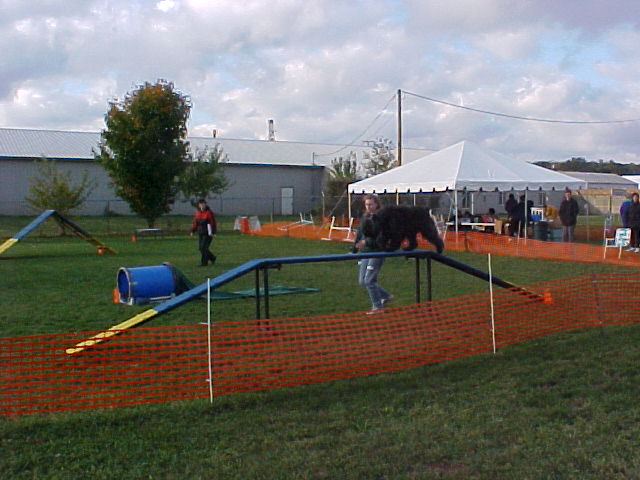 Since Bouviers single track, this is a breeze for Maggie. No fear of heights here. |
|
In UKC Agility, there are 13 obstacles in a Level I Agility Class. Each obstacle is numbered and the dog must complete each obstacle in that order. It is the handler's responsibility to direct the dog towards the right piece of equipment. This demonstrates the handlers ability to control the dog while running though the course. |
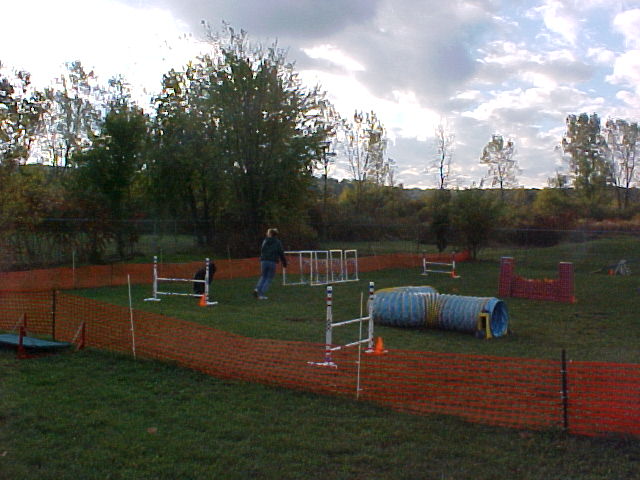 The hardest part for the Lee Ann is keeping up with Maggie. |
|
A-Frame Objective: The dog scales the A-frame quickly, scrambles over the apex and immediately runs to the bottom, touching the downside contact zone. This obstacle consists of two panels connected along their narrow edges and positioned to form a structure similar to an A-frame. Again, the dog must touch the contact area for safety reasons, failing to do so is a disqualification. The A-Frame is about 5 feet in height. |
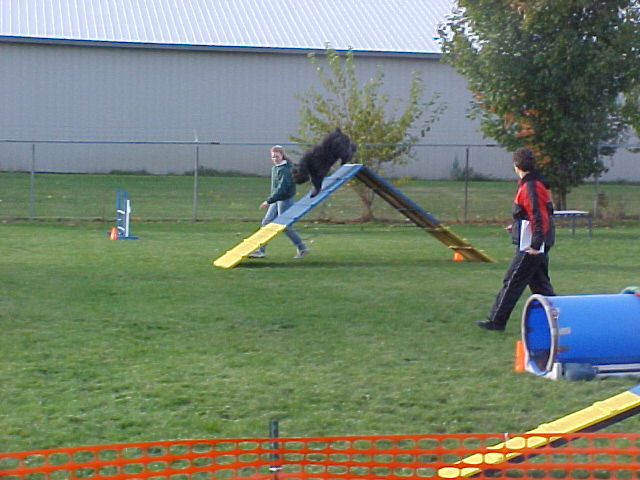 Judge Kim Smith watches carefully to be sure Maggie touches the contact area. |
|
Open Tunnel - This obstacle consists of eight hoops that are held in place by a PVC pipe framework. They are set at alternating angles of approximately 60 degrees to one another, to form a zigzag pattern when seen from above. The dog must walk/run directly through all hoops. |
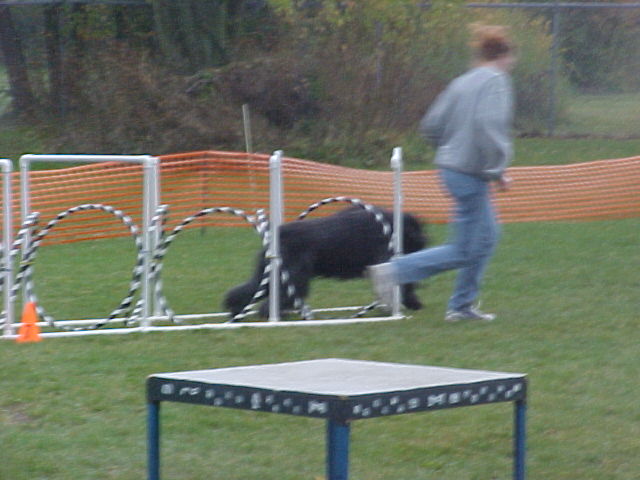 Maggie races straight through without a problem, although she did have to duck! |
|
Open Tunnel Objective: The dog runs at full speed to the entrance of the tunnel from any angle and exits quickly. Because this is one of the easiest obstacles to master, it's a good place to begin training. |
 |
|
Jumps Objective: The dog soars over the bar, panel, double or triple jump from any angle and at a proper distance, without displacing a bar or board. The dog should clear each bar or board without jumping excessively high. There are three height divisions for small, medium and large dogs. |
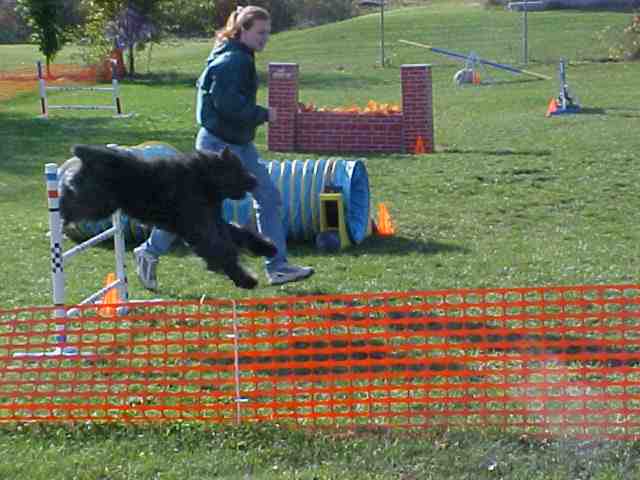 Running and Jumping are Maggie's specialties!! |
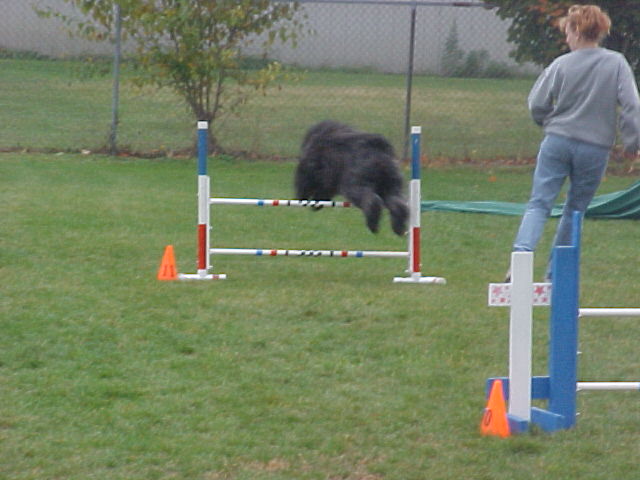 Maggie is in Height Division III and has a jump height of 20 inches. |
|
Pause Table Objective: The dog leaps onto the table, and when commanded to down or sit, complies swiftly and awaits the next command. During a five-second count, the dog remains firmly in position, then springs from the table immediately when the handler gives the next command. It demonstrates control over the dog. While running and jumping through the course, a handler must be able to prove that the dog will stop and stay on command. |
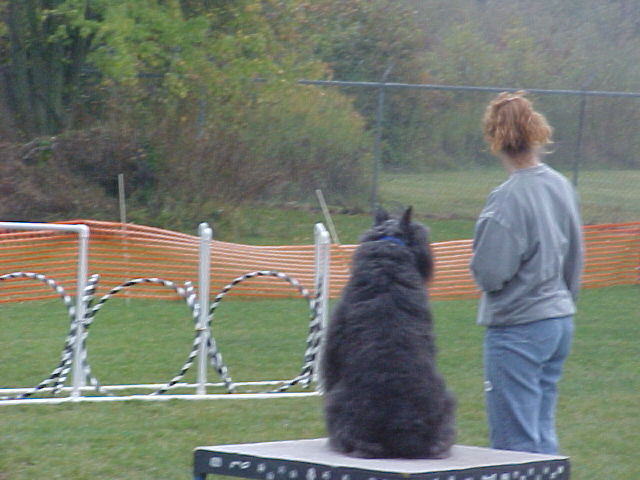
Maggie intently waits for the next signal from Lee Ann while looking for the next obstacle. |
|
Seesaw Objective: The dog squarely approaches the seesaw and touches the upside contact zone. The dog moves swiftly to the end of the plank, hesitating slightly at the pivot point, touches the downside contact zone, and exits after the plank has touched the ground. The teeter is 12-inches wide and supported on a steel or wooden base that allows the board to pivot freely at the center point. The angle of incline of approximately 20-degrees. |
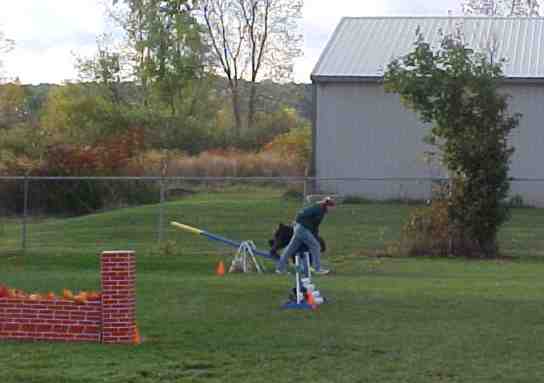 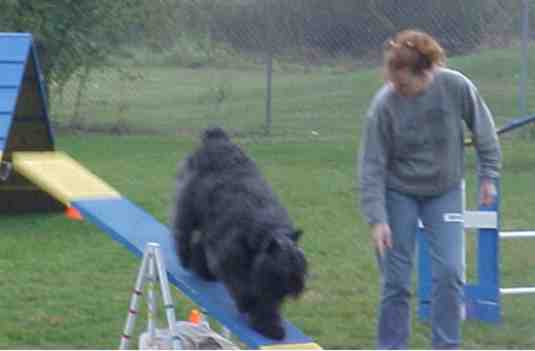 Lee Ann directs Maggie to continue now that she has made the Teeter-totter pivot. |
|

|
The dog's score determines the U-ACH points earned: |
|
|
Score of 200 = 10 UACH points |
|
|
Score of 199 = 6 UACH points |
|
|
Score of 198 = 4 UACH points |
|
|
Score of 197 = 2 UACH points |
|
|
Score of 196 = 1 UACH points |
|
|
To give you an idea of difficulty, if the dog performs an obstacle incorrectly they are deducted 5 points from their score. Even if the rest of the run was flawless, they would still only end up with a 195, thus no UACH points are awarded. To earn a 196 or better ~"perfection" is required! |
|
Agility Champion Excellent Title (UACHX): This
title is earned by earning five qualifying scores in the
Agility III class. A qualifying score in Agility III
requires the successful completion of all obstacles and a
score of 196 or more. Dog must correctly complete the
obstacle on the first attempt. |